Pharmaceutical Biotechnology (M.Sc.)
What makes this degree programme special?
- Focus on red biotechnology: from the cause of disease to molecular diagnostics to pharmaceutical agents
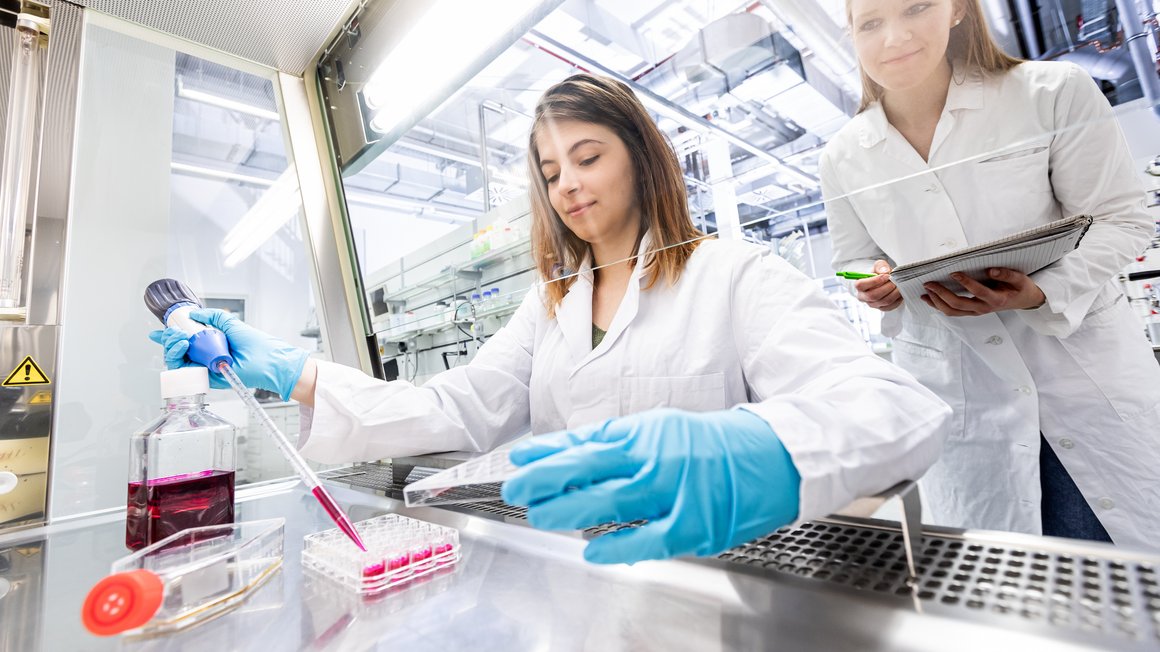
- Work in modern laboratories: cell culture, genetic engineering, enzyme technology, virology – learn directly from experiments
- Real research experience: master's thesis in a company or research institute – with the option to study abroad
What is the structure of the programme?
The Master's programme in Pharmaceutical Biotechnology has a standard period of study of four semesters. The first three semesters provide in-depth, scientifically oriented training in biotechnological core areas such as genetic engineering, enzyme technology, recombinant products, low-molecular active pharmaceutical ingredients and molecular medicine. Application-oriented teaching content is taught in engineering subjects such as bioprocess engineering, bioprocess development, cell culture technology and bioprocess control.
In the third semester, you also have the opportunity to specialise in elective modules based on your individual interests. In the fourth semester, you will write your Master's thesis. The aim is the independent scientific treatment of a topic in basic or applied research. The Master's thesis is usually written in a company or in a university-internal/external research institution and is supervised by professors from the Department of Medical Technology and Biotechnology.
Module overview
What are the entry requirements?
The formal admission requirements are regulated by the study regulations of the Master's degree programme in Pharmaceutical Biotechnology (see aptitude procedure regulations in the appendix of the study regulations).
Essential prerequisites for admission to the study programme are:
- a degree in a Bachelor's or Diploma degree programme, in particular in the fields of biotechnology, bioprocess engineering, medical biotechnology, pharmaceutical biotechnology, pharmaceutical chemistry, pharmaceutical engineering, pharmaceutical and chemical engineering or biopharmaceutical technology
- Knowledge of the fundamentals of natural sciences and engineering, such as mathematics, physics, computer science, electronics, biology and chemistry
- Knowledge of biochemistry, process analytics, genetic engineering, microbiology, cell biology, bioprocess engineering and bioprocess MSR technology
Prospective students should ideally have a bachelor's degree in biotechnology and a strong interest in solving interdisciplinary problems. An enthusiasm for all stages of the pharmaceutical-biotechnological value chain - from the molecular target to the marketable pharmaceutical product - is expected.
In addition, successful admission also requires a positive result in the internal selection procedure. The following characteristics are taken into account.
- The overall grade of the bachelor's or diploma degree (max. 65 points)
- Publications, posters or scientific presentations (up to 10 points)
- Substance and persuasiveness of the motivation letter (up to 5 points)
- Professional training and professional experience in the biotechnological field (up to 10 points)
- Additional specialist qualifications in the biotechnological field (up to 10 points)
- Recommendations of academic referees (up to 10 points)
For admission, the applicant must score at least 60 out of a maximum of 110 points.
What career prospects do I have after completing my studies?
The Master's programme in Pharmaceutical Biotechnology aims to train graduates who can be employed in all areas of red biotechnology. The focus of the training is on target-oriented drug discovery and development as well as the development and optimisation of biotechnological manufacturing processes for small molecule and recombinant pharmaceutical products.
Accordingly, you will find career prospects in the following areas:
- biotechnological pharmaceutical companies
- biotechnological research institutes and R&D service companies
- diagnostic companies, institutes and laboratories
- manufacturers of biotechnological production plants
- Manufacturers of devices, equipment and apparatus for biotechnology
- Manufacturers of diagnostic and analytical equipment
- Investigation offices, approval and licensing authorities, public institutions
- Consulting, freelance professions
The Master's degree qualifies students for a career in the higher civil service. It also opens up the possibility of a doctorate to particularly high-achieving students.
Who should I contact if I have any questions?
Where can I find further information?
Visit our events, meet students and teaching staff, and explore the campus.
