Midwifery (B.Sc.)
What makes this degree programme special?
- Academic midwifery training with several years of experience: the university is one of the few in Germany with an established range of courses in this field.
- Interdisciplinary modules promote teamwork and communication with students from other health professions and human medicine.
- Close integration of theory and practice through a study model with cooperating clinics, birthing centers, and midwifery practices.
- Rotation principle and externship: getting to know different levels, models, and environments of care
- Elective modules in the 7th semester for your own content focus
What is the structure of the programme?
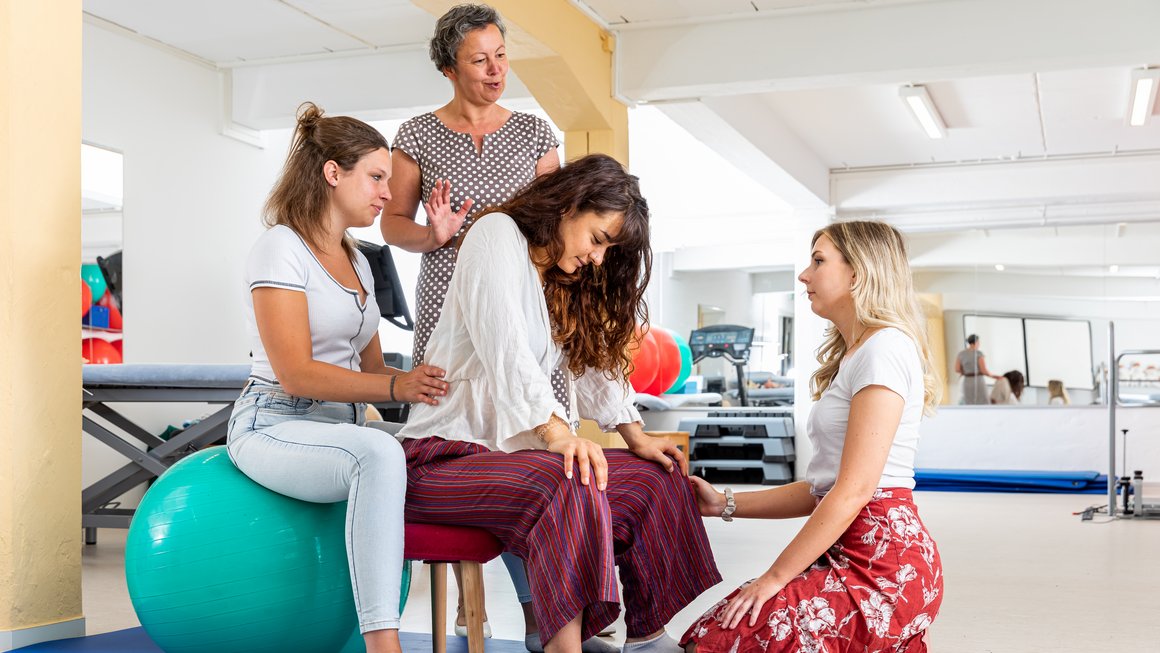
The primary qualifying and dual full-time degree program consists of a university-based and a practical work-based component. The program provides you with comprehensive training and scientific foundations to prepare you for the complex demands of caring for women and their families during the reproductive phase of life, from physiology to irregularities/pathology. The theoretical and practical teaching and learning events take place in two dimensions at the University of Applied Sciences Jena. Theoretical knowledge is trained in realistic simulation scenarios in the skills lab in order to optimally introduce the practical part of the program. The practical part of the course, as the third learning dimension, takes place in a clinical environment with cooperating practice partners (responsible practice facility/vPE) and is expanded to include cooperation partners (birth centers, midwife practices, midwives) in the non-clinical care environment.
In the degree programme, the competences formulated in the Midwives Act (HebG) are acquired, which enable graduates to act in a science-based manner in complex obstetric situations, to understand and evaluate obstetric knowledge and to implement decisions on care and support in pregnancy, birth and the postpartum period in a needs- and resource-oriented manner in the interest of promoting the health of women and families while respecting self-determination. In addition to this acquisition of competences, the content focus of the study programme is on enabling graduates to develop and implement innovative care models that take into account current and future developments in health care. In addition to midwife-led delivery rooms, these care models include, in particular, outpatient midwifery care and interprofessional care networks that also function with digital support, as well as cross-setting and diversity-sensitive care offers. In addition to life sciences, legal, economic, ethical, social and cultural science theories, concepts and methods are taught.
The programme is structured dynamically over 8 semesters. Modules from theory and practice alternately intertwine and thereby sharpen and deepen the acquired competences.
Key Topics
Module overview
What are the entry requirements?
- higher education entrance qualification (Abitur), subject-related higher education entrance qualification or entrance qualification for a university of applied sciences (Fachhochschulreife)
- you don't have a higher education entrance qualification but you have work experience? Find out about studying without High School Diploma.
Did you complete your school or university education abroad? Please note the admission requirements for studying in Germany.
OR
- Completion of vocational training in accordance with the provisions of the Hebammengesetz (HebG §10) (e.g. health and nursing care professional, paediatric health and nursing care professional, nursing specialist, nurse)
It is necessary to conclude a training contract with a cooperating institution of the University of Applied Sciences Jena. Applications must be submitted to the relevant hospital, observing the application deadlines and the application documents to be submitted.
In order to conclude the training contract at the cooperating institution and to enrol, an extended certificate of good conduct and a medical certificate of professional aptitude must be provided.
What career prospects do I have after completing my studies?
As a midwife, you are responsible for providing comprehensive healthcare to people during pregnancy, childbirth, the postpartum period, and breastfeeding. Midwives work closely with other healthcare professionals and doctors. Midwife-specific healthcare is provided in various settings: in midwifery practices and birthing centers, in clinics offering different levels of care, in gynecological practices, and also in home environments.
In inpatient primary care during pregnancy, childbirth, the postpartum period, and breastfeeding, you can work in prenatal consultations, in the prenatal ward, in the (midwife-led) delivery room, in the maternity ward (mother-child department), in the breastfeeding clinic, in parenting classes, and also as a study midwife. In outpatient care, you can provide non-clinical or clinical midwife-led obstetric care and work as a course instructor.
You can obtain further qualifications with a focus on psychosocial or educational activities and work as a family midwife or practice instructor. In addition, you can become involved in professional politics in professional associations or work as academic staff at universities and participate in midwifery research and teaching.
Who should I contact if I have any questions?
Where can I find further information?
Visit our events, meet students and teaching staff, and explore the campus.


