A STUDY OF RESOLUTION-AWARE VIDEO COMPRESSION FOR REMOTEPHOTOPLETHYSMOGRAPHY
HiDURPA Dataset
HiDURPA (High Definition Uncompressed Remote Photoplethysmography Acquisition) is a high-definition raw video dataset designed for research in remote photoplethysmography (rPPG). The dataset includes recordings from 11 participants (4 female, 7 male), with five 30-second sessions per participant.
Recording setup
Participants were positioned approximately 1 meter in front of the camera and were instructed to stand still during acquisition. Video was captured using a Blackmagic Pocket Cinema Camera 4K and illuminated with two softboxes to ensure consistent lighting. The recordings were acquired via a Blackmagic DeckLink Mini Recorder 4K capture card in uncompressed YUV422 at 30 fps.
Ground truth measurements
To provide reliable reference signals for validation, the following ground truth data were recorded: ECG using a Polar H10; BVP and SpO2 waveforms using a VTM20F.
Availability & access
The dataset will be released upon publication of the paper “A Study of Resolution-Aware Video Compression for Remote Photoplethysmography”. Access is restricted to research groups and research institutions and requires a signed Data Usage Agreement (DUA).
Supplementary information
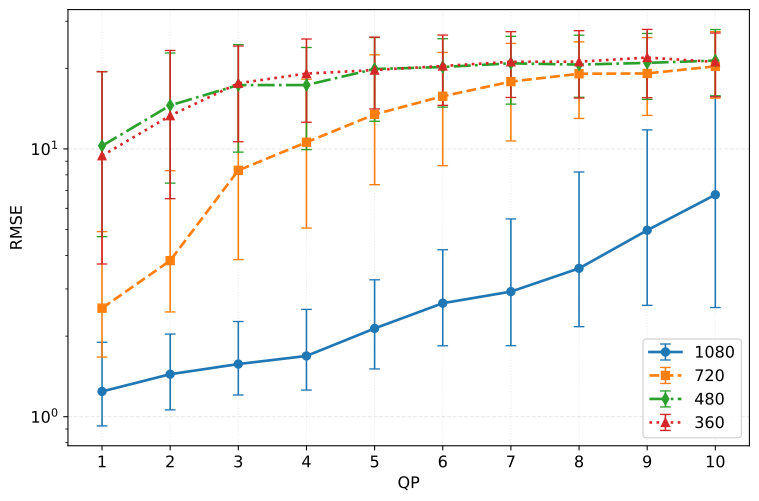
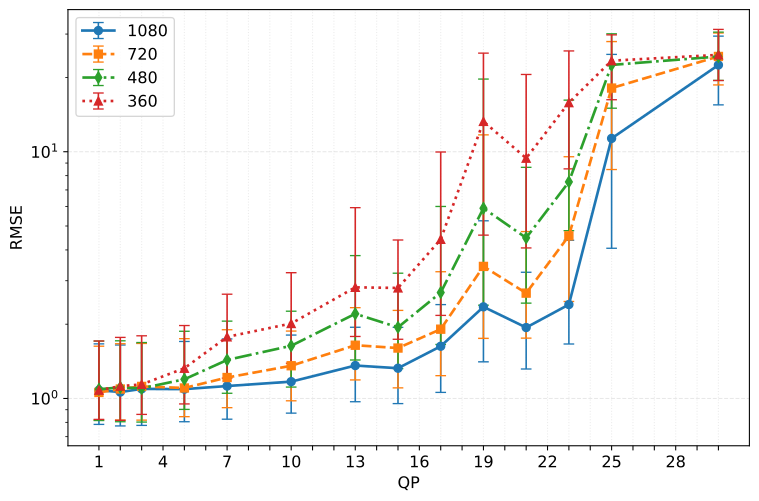
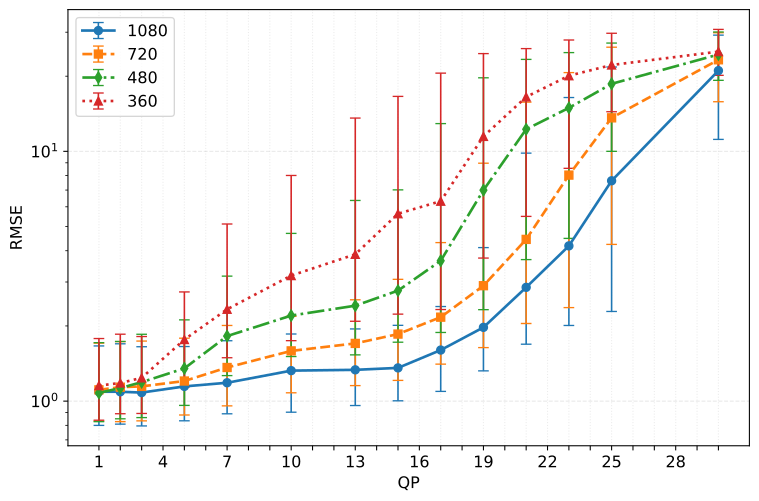
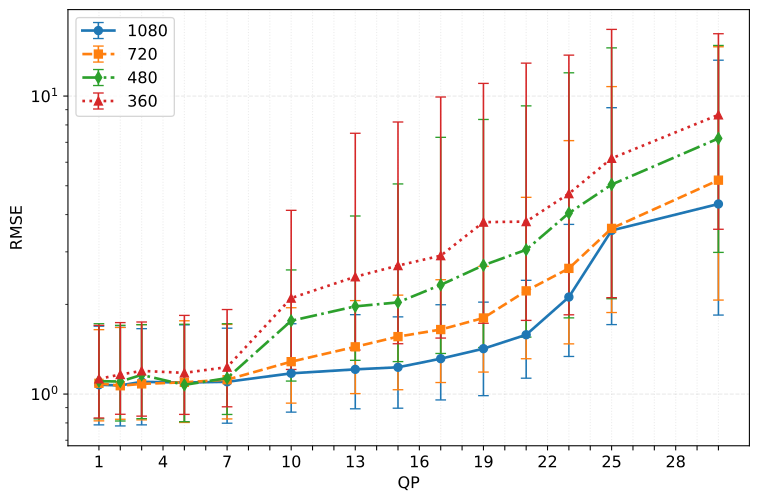
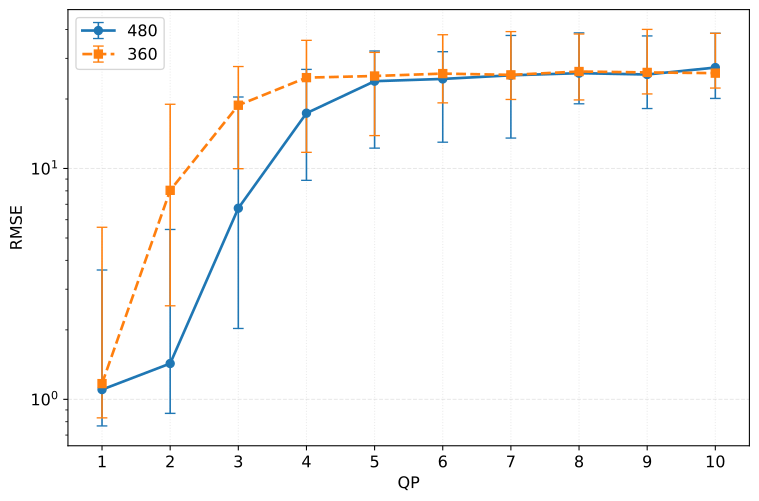
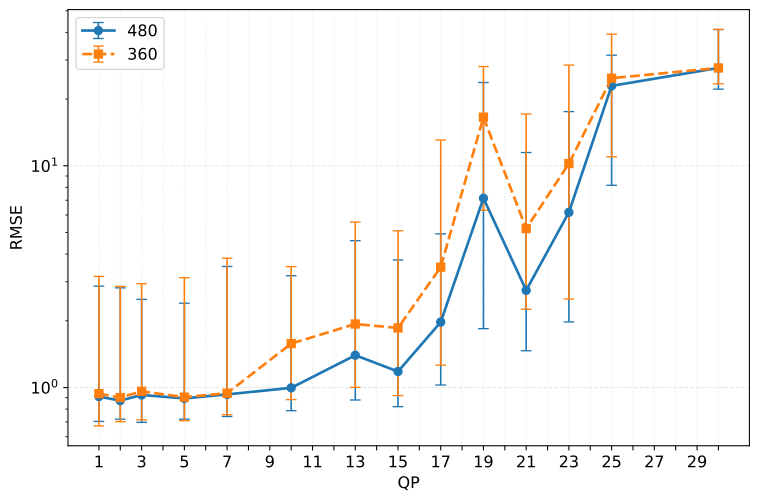
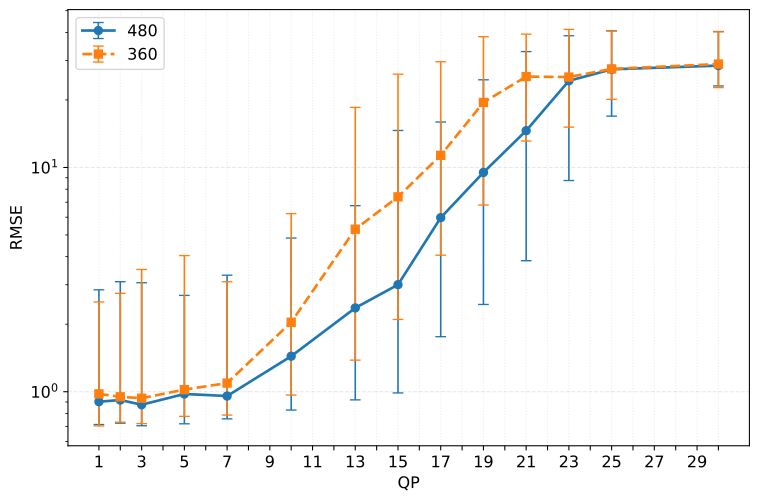
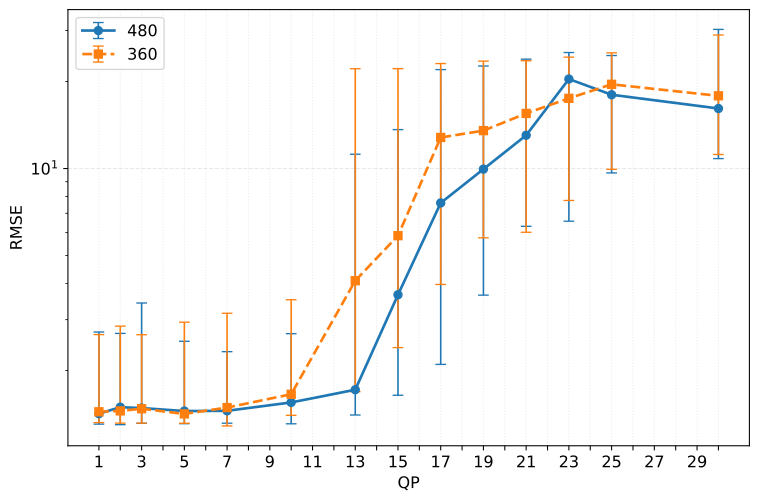
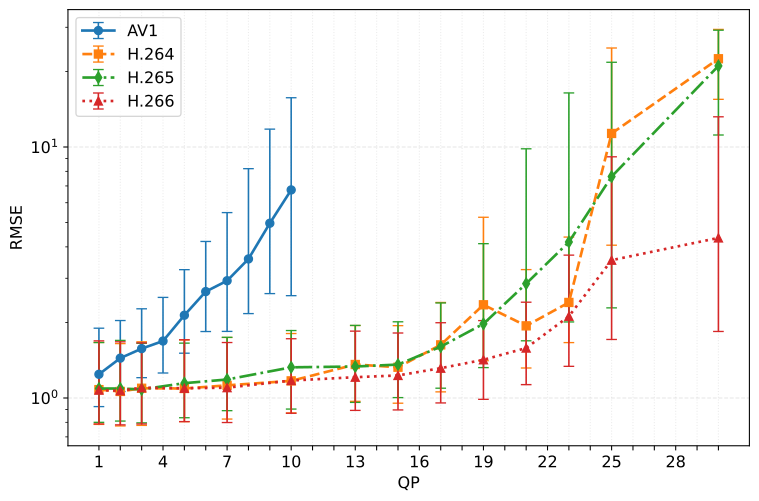
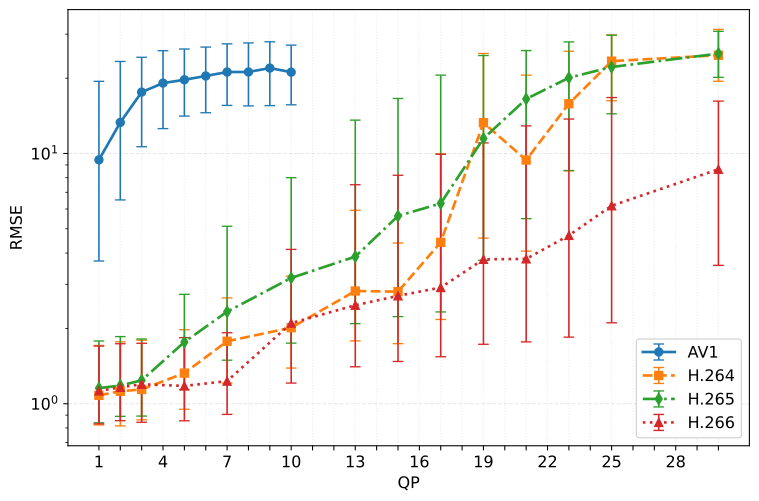
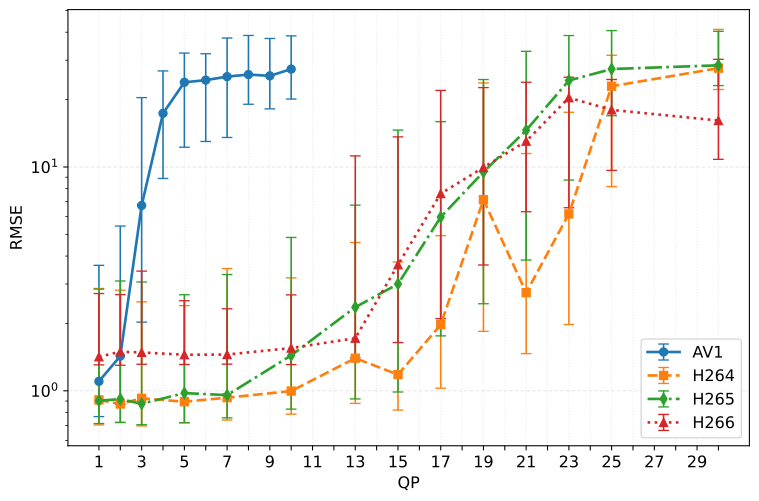
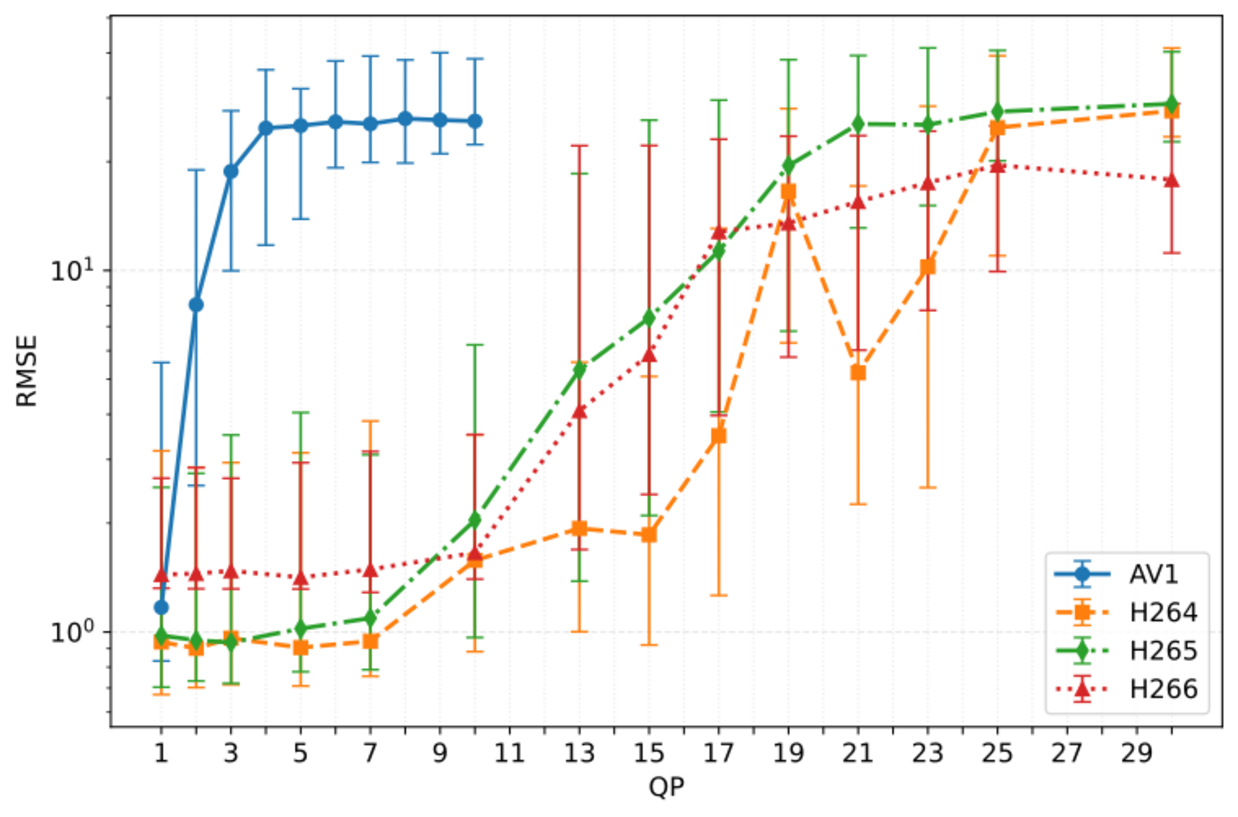
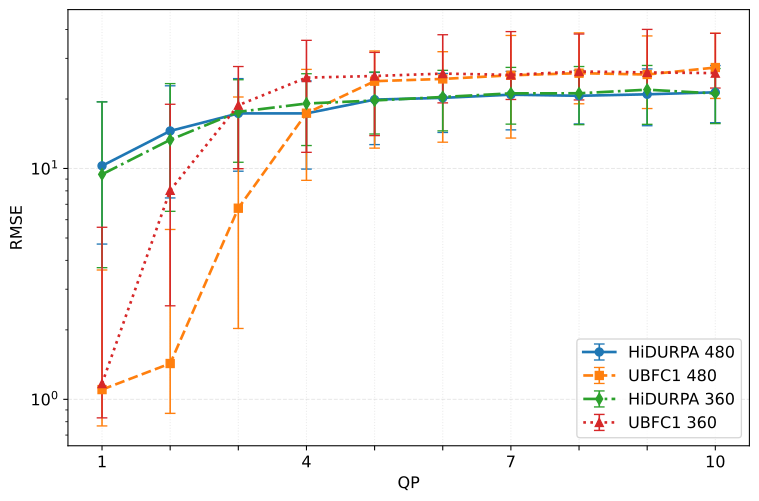
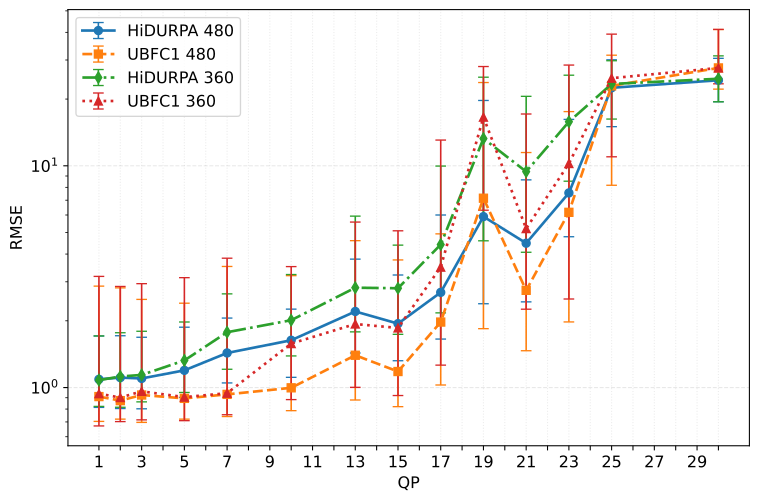
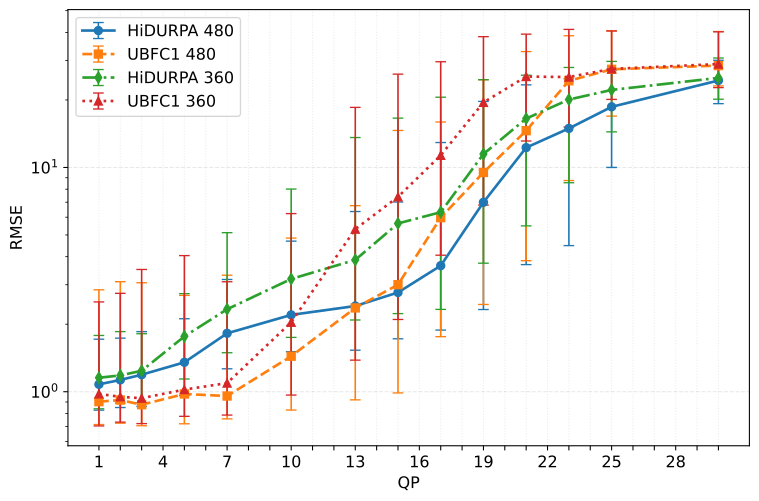
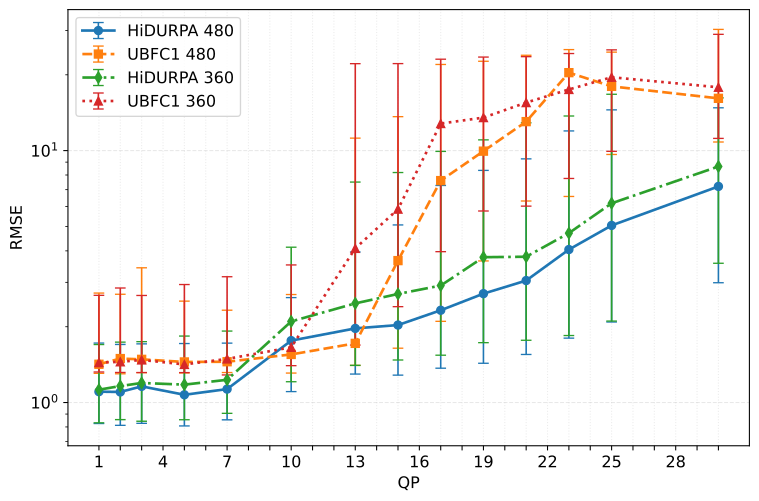
This section provides supplementary material to complement the paper, presenting the complete tabulated results and accompanying figures from our experiments on resolution- and compression-aware remote photoplethysmography (rPPG). The tables report rPPG performance (mean ± standard deviation) across different video codecs (H.264/AVC, H.265/HEVC, H.266/VVC, and AV1), quantization parameter (QP) settings, and spatial resolutions on the HiDURPA and UBFC1 datasets. The figures summarize rPPG performance (median ± interquartile range) across codecs, QP levels, spatial resolutions, and datasets.
Pixel format and chroma subsampling
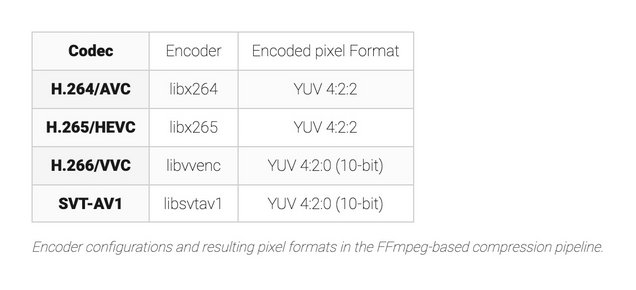
The HiDURPA master recordings are captured as uncompressed YUV 4:2:2 (10-bit) at 1080p, 30 fps. During encoding, the four codecs in the FFmpeg-based compression pipeline use the following pixel formats:
Table of the encoder configurations and resulting pixel formats in the FFmpeg-based compression pipeline: H.264/AVC (libx264) and H.265/HEVC (libx265) encode in YUV 4:2:2, while H.266/VVC (libvvenc) and SVT-AV1 (libsvtav1) encode in YUV 4:2:0 (10-bit).
The 4:2:2 to 4:2:0 conversion for H.266/VVC and SVT-AV1 is a practical constraint, since libvvenc and libsvtav1 do not support 4:2:2 or 4:4:4 input. Because rPPG relies on chrominance variations, the reduced horizontal chroma resolution is treated as an inherent part of the respective codec pipeline rather than a separately analysed factor. Before rPPG analysis, all compressed videos are decoded back to YUV 4:2:2 for HiDURPA and to bgr24 for UBFC1, ensuring a uniform pixel format input to the analysis pipeline per dataset.
ICA failure cases
Among the five rPPG methods we evaluate (GREEN, ICA, CHROM, LGI, and OMIT), the ≈4 % of sequences for which no valid heart-rate estimate could be extracted are specific to ICA. ICA (JADE) begins with a whitening step that eigendecomposes the per-window 3×3 RGB covariance and rescales the signal by the inverse square roots of its eigenvalues. Under strong compression (aggressive quantization, 4:2:0 chroma subsampling, inter-frame skip/merge coding, and downscaling), the minute pulsatile chrominance variation is suppressed, so the three colour channels become dominated by a common luminance component and nearly collinear. The covariance then becomes effectively rank-deficient (its smallest eigenvalue approaches zero) and the whitening rescaling becomes numerically ill-defined, which causes the eigenvalue-inversion step to fail. The other four methods require no such inversion (GREEN selects the green channel directly, CHROM applies a fixed linear colour projection, LGI uses the leading left singular vector, and OMIT a QR decomposition) and produced no numerical failures on the same sequences. We emphasize, however, that this refers only to the absence of numerical breakdown: under such heavy compression the estimation accuracy of all methods degrades, so the greater numerical resilience of the projection-based methods does not by itself imply accurate heart-rate recovery.
Participant demographics
The dataset comprises 11 adult participants (7 male, 4 female), each recorded in five 30 s clips (55 clips total) at 1920×1080, 30 fps, under stable, diffuse illumination, with synchronized ECG as ground truth. Among the seven male participants, five were aged 20–30, one 30–40, and one 40–50. Among the four female participants, three were aged 20–30 and one 30–40. Overall, 8 of the 11 participants were aged 20–30, 2 were aged 30–40, and 1 was aged 40–50.
TABLES – rPPG Performance (mean RMSE ± standard deviation) and video file sizes for multiple QPs and video codecs on HiDURPA and UBFC1 datasets:
Show larger version for:
Table of rPPG performance (mean RMSE ± standard deviation) and video file sizes for the H.264/AVC codec (libx264) at multiple quantization parameter (QP) settings and spatial resolutions (1080p, 720p, 480p, 360p) on the HiDURPA dataset.
Show larger version for:
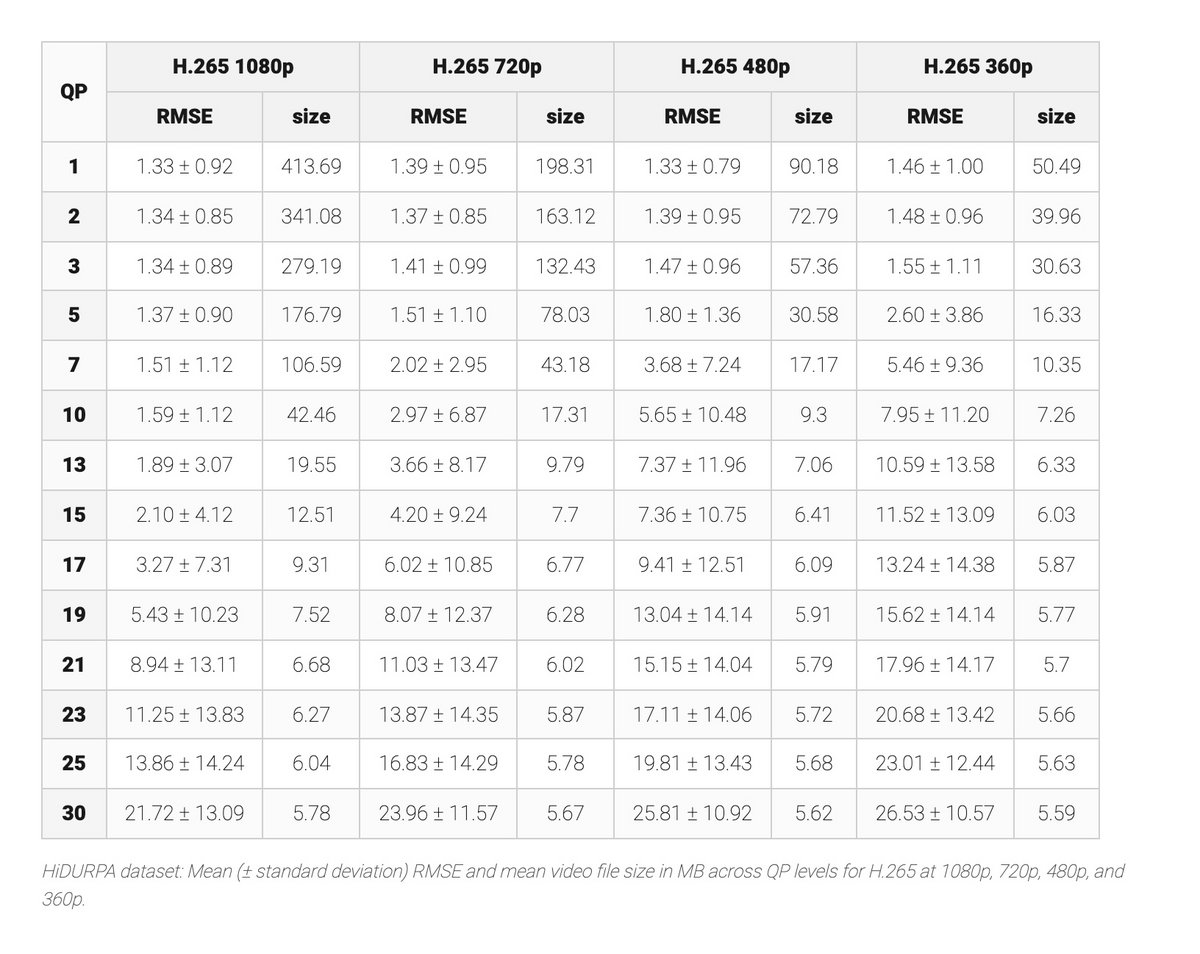
Table of rPPG performance (mean RMSE ± standard deviation) and video file sizes for the H.265/HEVC codec (libx265) at multiple quantization parameter (QP) settings and spatial resolutions (1080p, 720p, 480p, 360p) on the HiDURPA dataset.
Show larger version for:
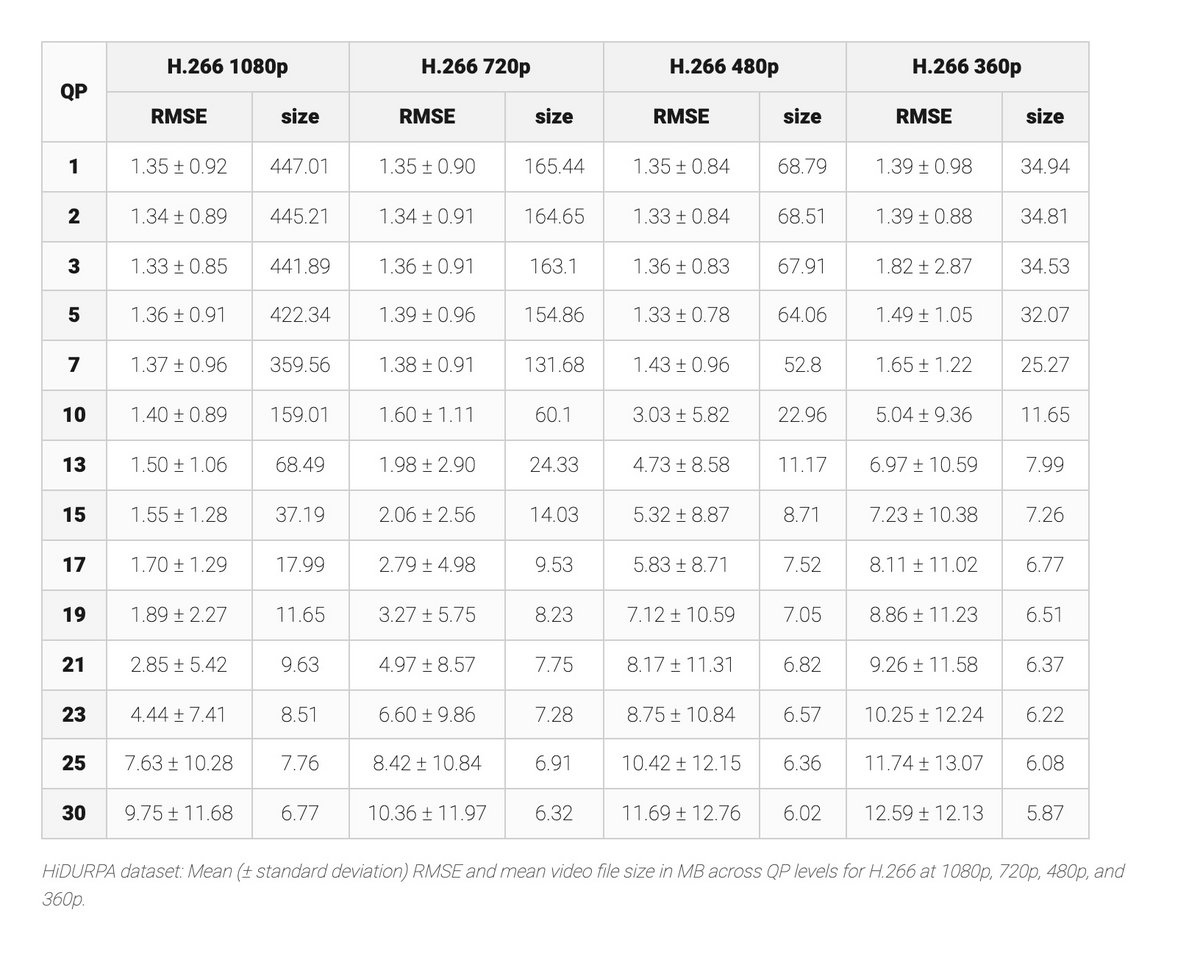
Table of rPPG performance (mean RMSE ± standard deviation) and video file sizes for the H.266/VVC codec (libvvenc) at multiple quantization parameter (QP) settings and spatial resolutions (1080p, 720p, 480p, 360p) on the HiDURPA dataset.
Show larger version for:
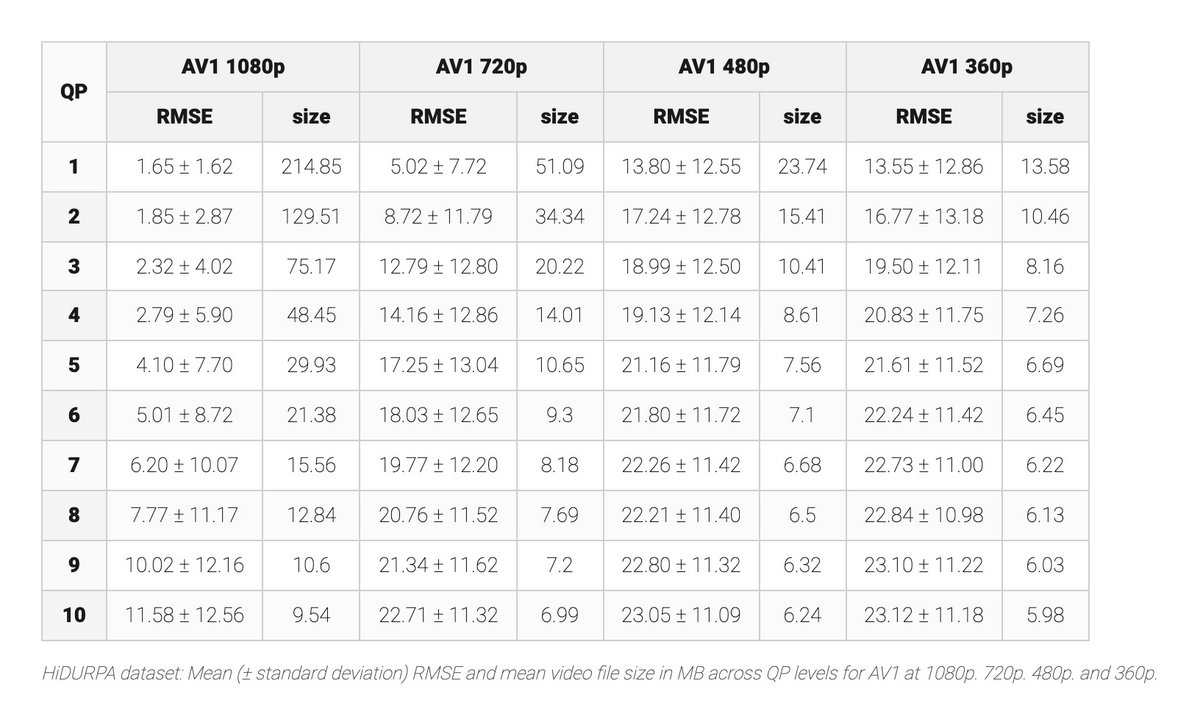
Table of rPPG performance (mean RMSE ± standard deviation) and video file sizes for the SVT-AV1 codec at multiple quantization parameter (QP) settings and spatial resolutions (1080p, 720p, 480p, 360p) on the HiDURPA dataset.
Show larger version for:
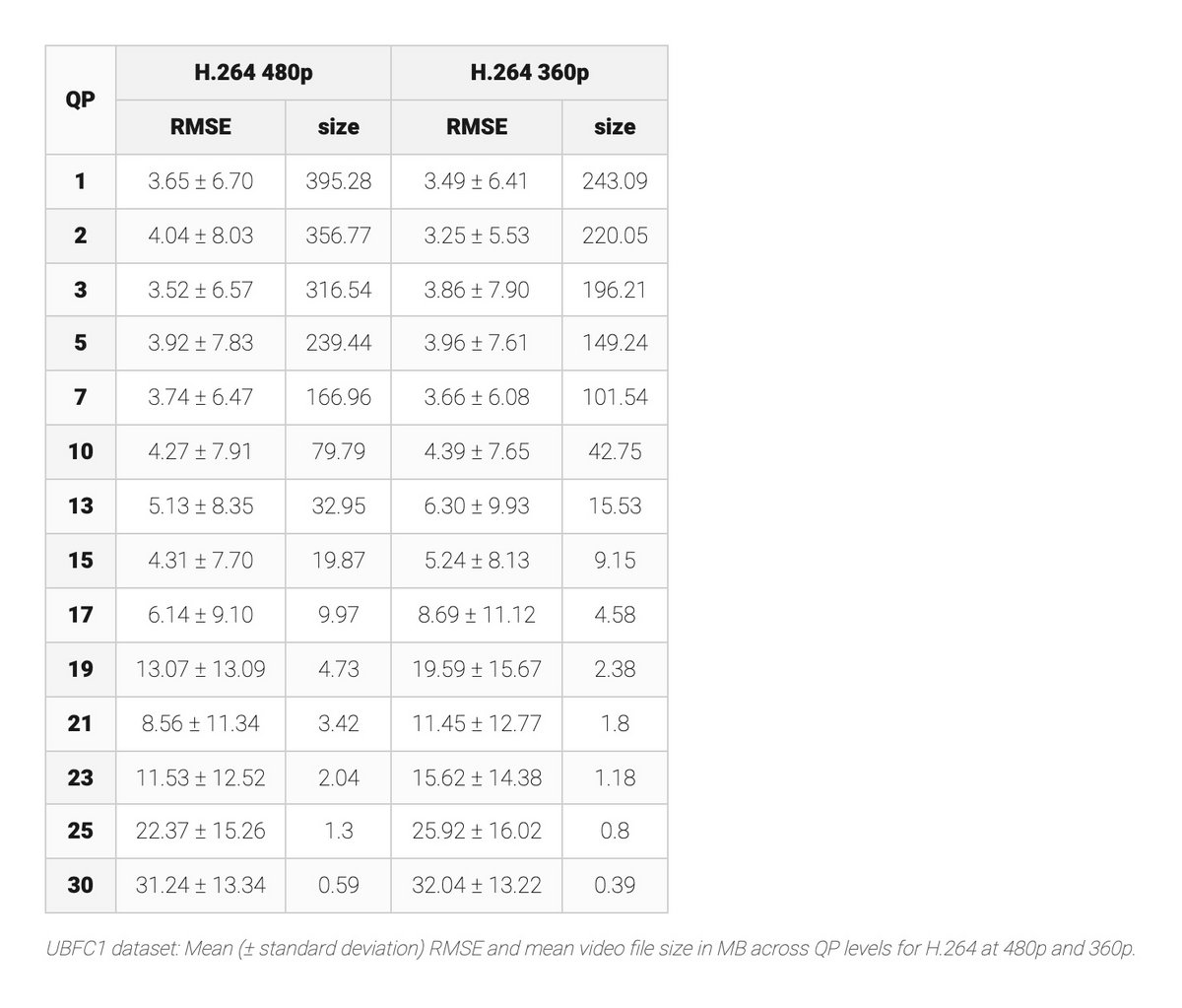
Table of rPPG performance (mean RMSE ± standard deviation) and video file sizes for the H.264/AVC codec (libx264) at multiple quantization parameter (QP) settings and spatial resolutions (480p, 360p) on the UBFC1 dataset.
Show larger version for:
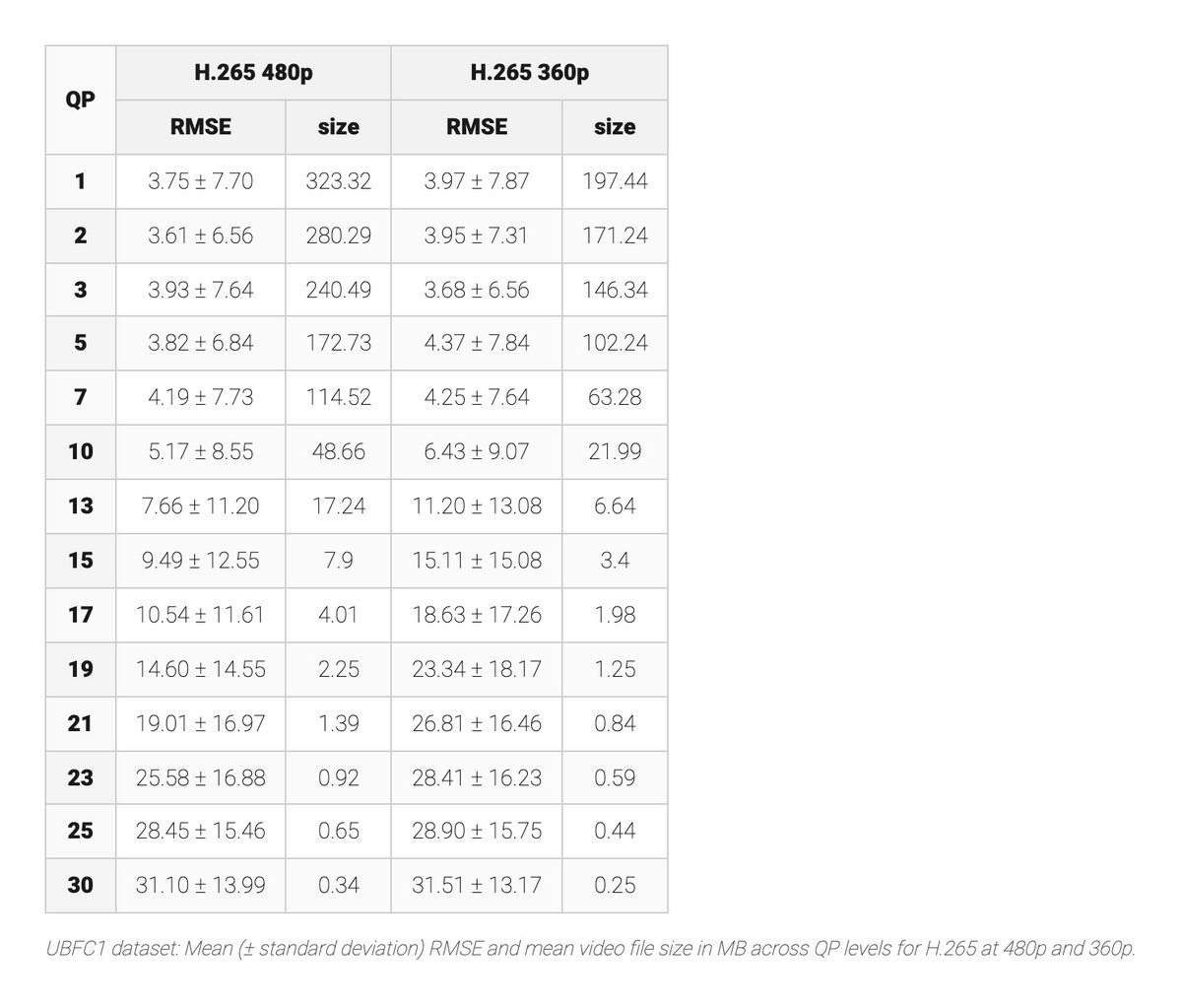
Table of rPPG performance (mean RMSE ± standard deviation) and video file sizes for the H.265/HEVC codec (libx265) at multiple quantization parameter (QP) settings and spatial resolutions (480p, 360p) on the UBFC1 dataset.
Show larger version for:
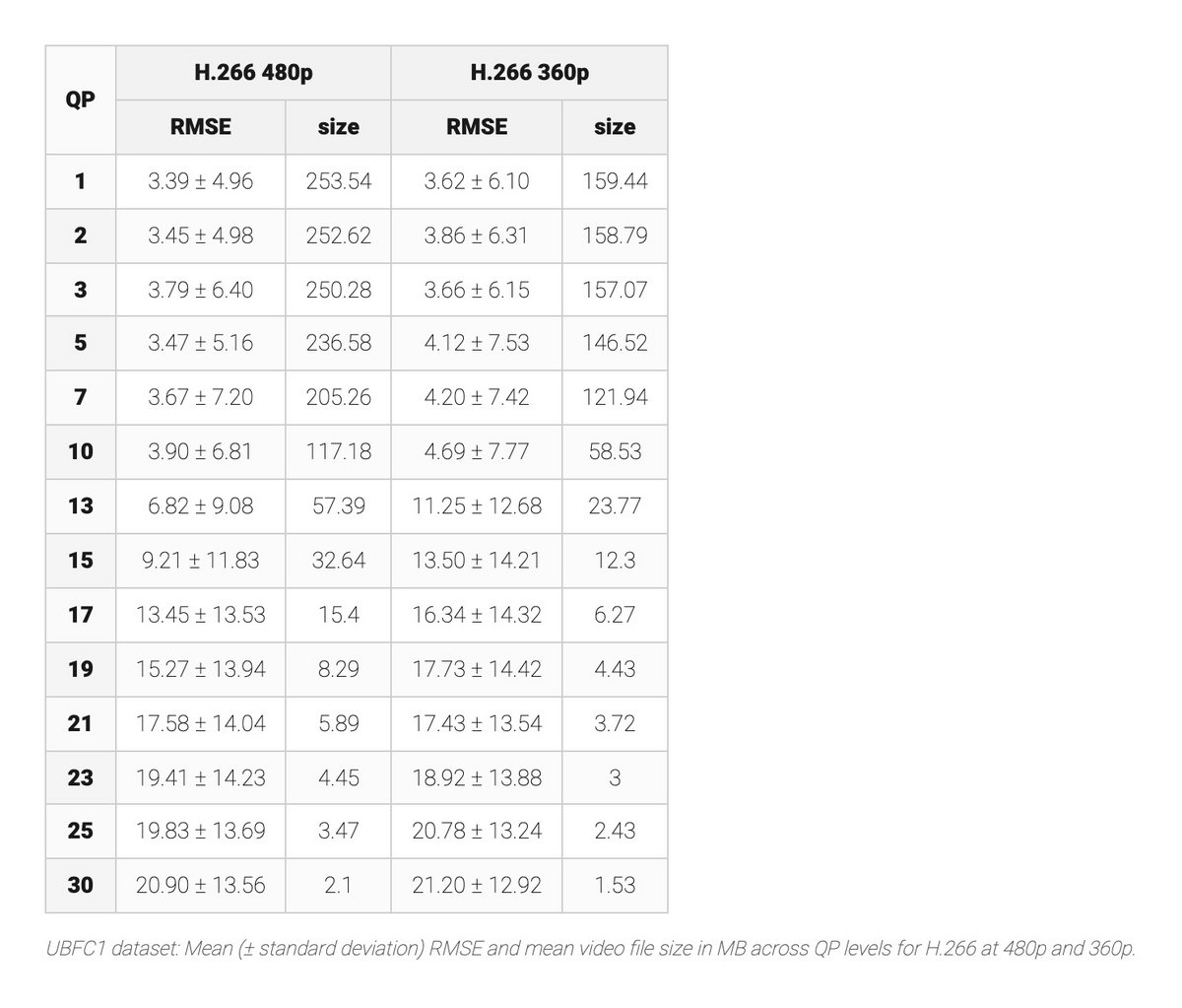
Table of rPPG performance (mean RMSE ± standard deviation) and video file sizes for the H.266/VVC codec (libvvenc) at multiple quantization parameter (QP) settings and spatial resolutions (480p, 360p) on the UBFC1 dataset.
Show larger version for:
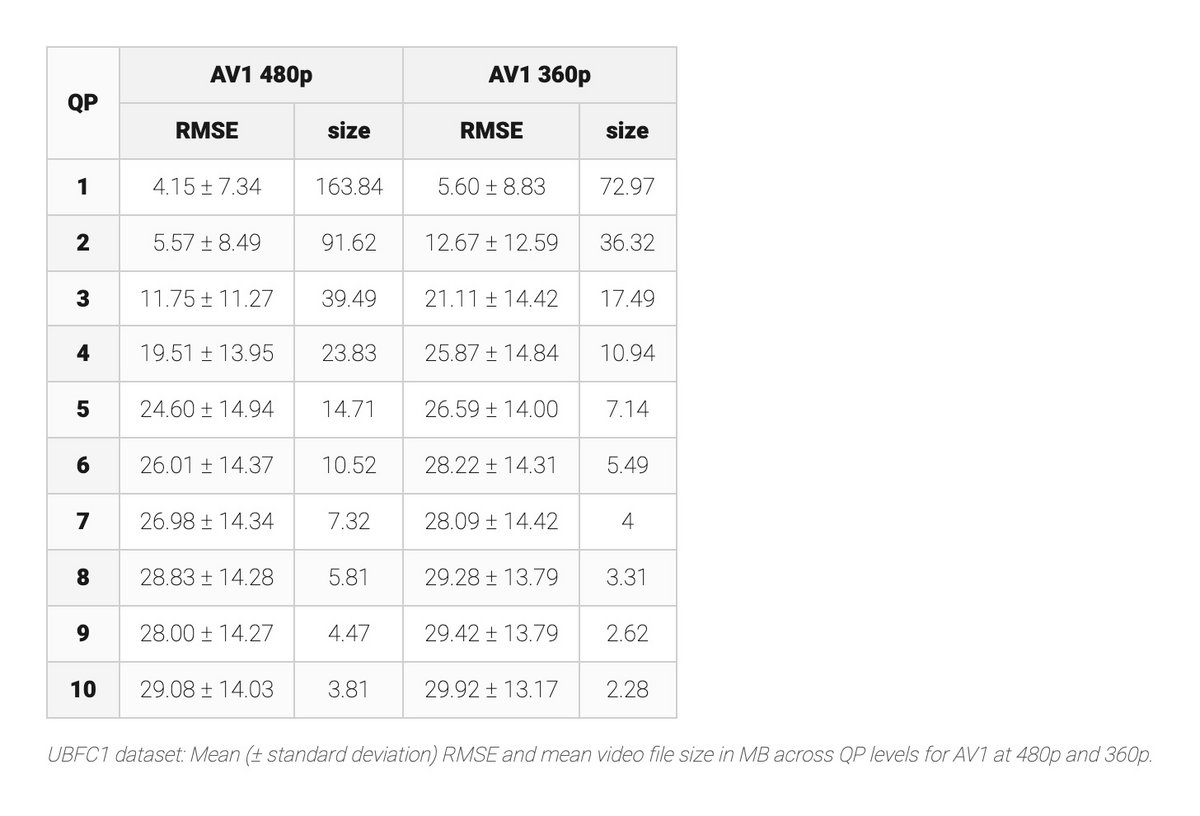
Table of rPPG performance (mean RMSE ± standard deviation) and video file sizes for the SVT-AV1 codec at multiple quantization parameter (QP) settings and spatial resolutions (480p, 360p) on the UBFC1 dataset.
Figures – rPPG Performance (median RMSE and interquatil ranges) over multiple QPs
HiDURPA: Performance by codec — resolution as separate lines
Show larger version for:
Line chart of rPPG performance (median RMSE ± interquartile range) for the SVT-AV1 codec on the HiDURPA dataset, with each spatial resolution (1080p, 720p, 480p, 360p) shown as a separate line over multiple quantization parameter (QP) levels.
Show larger version for:
Line chart of rPPG performance (median RMSE ± interquartile range) for the H.264/AVC codec on the HiDURPA dataset, with each spatial resolution (1080p, 720p, 480p, 360p) shown as a separate line over multiple quantization parameter (QP) levels.
Show larger version for:
Line chart of rPPG performance (median RMSE ± interquartile range) for the H.265/HEVC codec on the HiDURPA dataset, with each spatial resolution (1080p, 720p, 480p, 360p) shown as a separate line over multiple quantization parameter (QP) levels.
Show larger version for:
Line chart of rPPG performance (median RMSE ± interquartile range) for the H.266/VVC codec on the HiDURPA dataset, with each spatial resolution (1080p, 720p, 480p, 360p) shown as a separate line over multiple quantization parameter (QP) levels.
UBFC1: Performance by codec — resolution as separate lines
Show larger version for:
Line chart of rPPG performance (median RMSE ± interquartile range) for the SVT-AV1 codec on the UBFC1 dataset, with each spatial resolution (480p, 360p) shown as a separate line over multiple quantization parameter (QP) levels.
Show larger version for:
Line chart of rPPG performance (median RMSE ± interquartile range) for the H.264/AVC codec on the UBFC1 dataset, with each spatial resolution (480p, 360p) shown as a separate line over multiple quantization parameter (QP) levels.
Show larger version for:
Line chart of rPPG performance (median RMSE ± interquartile range) for the H.265/HEVC codec on the UBFC1 dataset, with each spatial resolution (480p, 360p) shown as a separate line over multiple quantization parameter (QP) levels.
Show larger version for:
Line chart of rPPG performance (median RMSE ± interquartile range) for the H.266/VVC codec on the UBFC1 dataset, with each spatial resolution (480p, 360p) shown as a separate line over multiple quantization parameter (QP) levels.
HiDURPA: Performance by resolution — codecs as separate lines
Show larger version for:
Line chart of rPPG performance (median RMSE ± interquartile range) at 1080p resolution on the HiDURPA dataset, with each codec (H.264/AVC, H.265/HEVC, H.266/VVC and AV1) shown as a separate line over multiple quantization parameter (QP) levels.
Show larger version for:
Line chart of rPPG performance (median RMSE ± interquartile range) at 360p resolution on the HiDURPA dataset, with each codec (H.264/AVC, H.265/HEVC, H.266/VVC and AV1) shown as a separate line over multiple quantization parameter (QP) levels.
UBFC1: Performance by resolution — codecs as separate lines
Show larger version for:
Line chart of rPPG performance (median RMSE ± interquartile range) at 480p resolution on the UBFC1 dataset, with each codec (H.264/AVC, H.265/HEVC, H.266/VVC and AV1) shown as a separate line over multiple quantization parameter (QP) levels.
Line chart of rPPG performance (median RMSE ± interquartile range) at 360p resolution on the UBFC1 dataset, with each codec (H.264/AVC, H.265/HEVC, H.266/VVC and AV1) shown as a separate line over multiple quantization parameter (QP) levels.
UBFC1 vs. HiDURPA: Performance by codec — resolutions as separate lines
Show larger version for:
Line chart comparing rPPG performance (median RMSE ± interquartile range) of the SVT-AV1 codec on the UBFC1 and HiDURPA datasets, with the individual spatial resolutions shown as separate lines over multiple quantization parameter (QP) levels.
Show larger version for:
Line chart comparing rPPG performance (median RMSE ± interquartile range) of the H.264/AVC codec on the UBFC1 and HiDURPA datasets, with the individual spatial resolutions shown as separate lines over multiple quantization parameter (QP) levels.
Show larger version for:
Line chart comparing rPPG performance (median RMSE ± interquartile range) of the H.265/HEVC codec on the UBFC1 and HiDURPA datasets, with the individual spatial resolutions shown as separate lines over multiple quantization parameter (QP) levels.
Show larger version for:
Line chart comparing rPPG performance (median RMSE ± interquartile range) of the H.266/VVC codec on the UBFC1 and HiDURPA datasets, with the individual spatial resolutions shown as separate lines over multiple quantization parameter (QP) levels.
Figures – rPPG Performance (median RMSE and interquatil ranges) over bitrate
UBFC and HiDURPA: RMSE vs. Bitrate cross-codec comparison
Show larger version for:
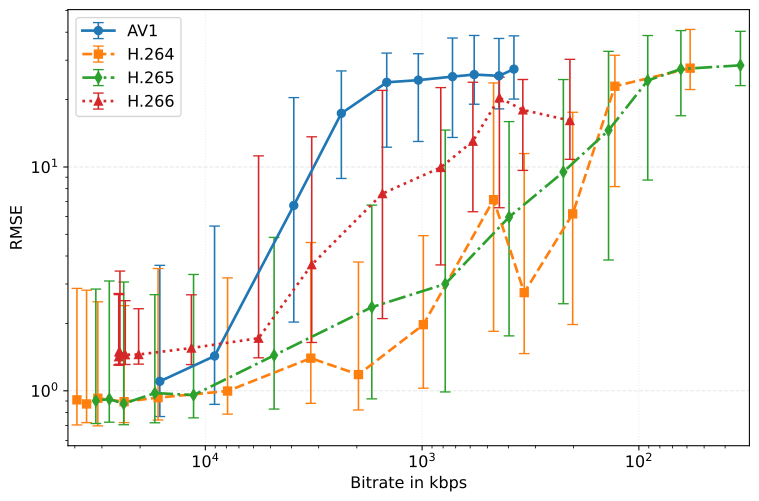
Scatter/line chart of rPPG performance (RMSE) versus video bitrate at 480p resolution on the UBFC1 dataset, comparing the four codecs (H.264/AVC, H.265/HEVC, H.266/VVC and AV1) as separate series.
Show larger version for:
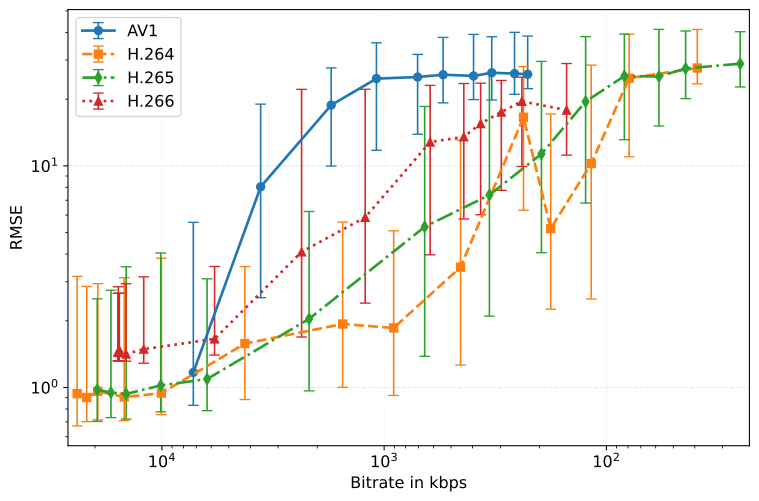
Scatter/line chart of rPPG performance (RMSE) versus video bitrate at 360p resolution on the UBFC1 dataset, comparing the four codecs (H.264/AVC, H.265/HEVC, H.266/VVC and AV1) as separate series.
Show larger version for:
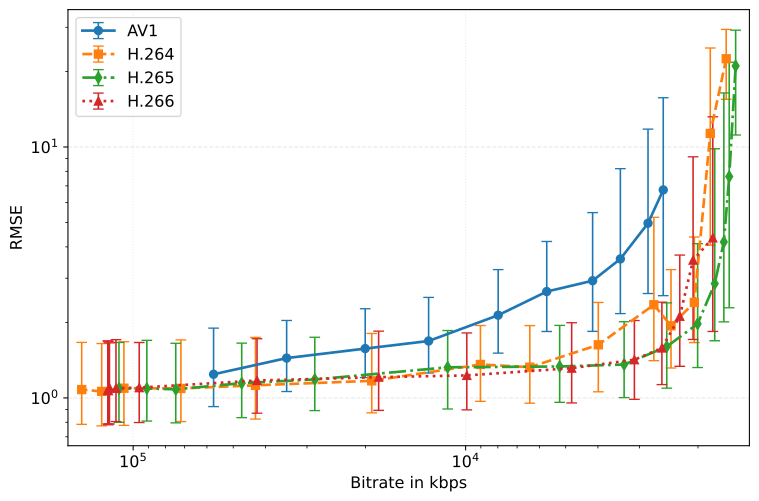
Scatter/line chart of rPPG performance (RMSE) versus video bitrate at 1080p resolution on the HiDURPA dataset, comparing the four codecs (H.264/AVC, H.265/HEVC, H.266/VVC and AV1) as separate series.
Show larger version for:
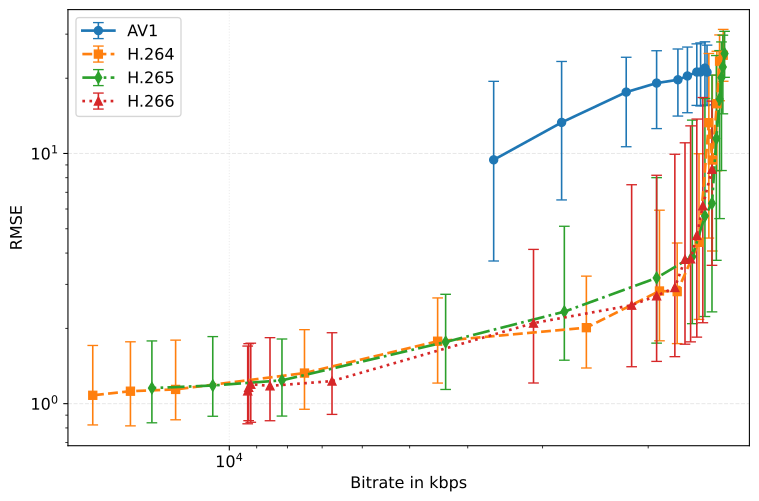
Scatter/line chart of rPPG performance (RMSE) versus video bitrate at 360p resolution on the HiDURPA dataset, comparing the four codecs (H.264/AVC, H.265/HEVC, H.266/VVC and AV1) as separate series.